Live trading Nifty, BankNifty and SENSEX with option buying as the 2026 expiry week demands strict risk control
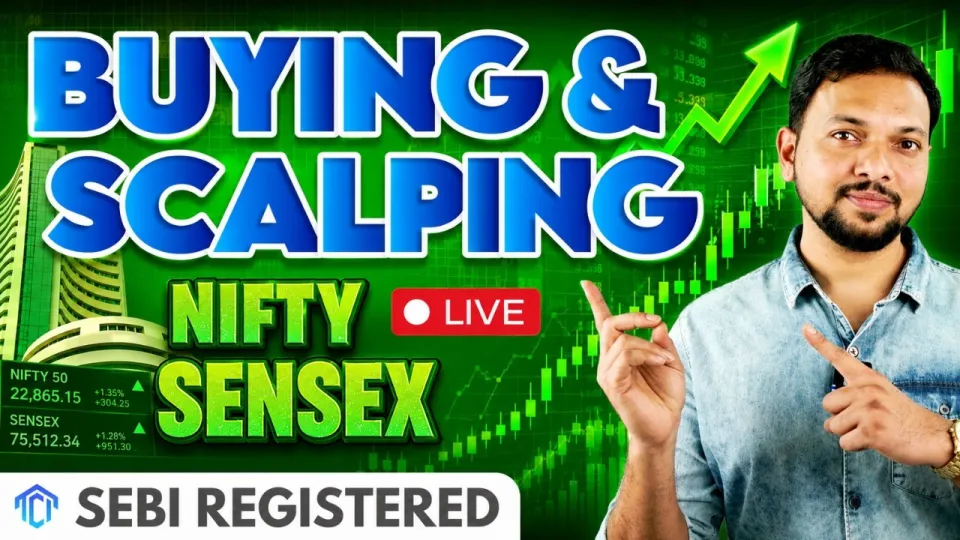
Video: LIVE TRADING Nifty BankNifty and SENSEX | Option Buying | 15 Oct #livetrading
You can order the same kind of articles for your own video to boost it on YouTube and Google. Just message the Telegram bot @sat_sit_bot. It writes articles around your video, embeds the video and publishes them on popular niche websites (no ads). Free trial — 50 articles.
· based on the channel TRADING CAFE INDIA
Key takeaways
- Live index option buying covers three instruments in one session: Nifty 50, BankNifty and SENSEX.
- SENSEX option strikes are spaced 100 points apart, so a 74,300 target implies specific strike selection, not a vague market call.
- BankNifty moves roughly 1.5–2x faster than Nifty in points, so the same stop-loss distance carries more risk per lot.
- A weekly index option premium can lose 30–50% of its value in a single session when the index stalls or reverses.
- TRADING CAFE INDIA is a SEBI-registered Research Analyst under registration INH000013767 and marks its content as educational.
Live trading on Nifty, BankNifty and SENSEX with option buying means taking intraday directional positions in index call and put options, where the trader picks a strike, pays a premium and manages the position within the session rather than holding stock. The format shown by TRADING CAFE INDIA on 15 Oct is a screen-share session across all three indices, and viewers who want the broker-side setup used in the stream can start with the Lemonn registration link before following any live call.
What live index option buying actually involves
Option buying is a premium-paid, limited-risk position: the maximum loss is the premium, but the probability of finishing in profit is lower than with selling strategies. In a live session across Nifty, BankNifty and SENSEX, the trader is doing four things at once — reading the index chart, choosing a strike, sizing the lot and deciding when to exit.
A few structural facts shape every decision:
- Nifty 50 and BankNifty options trade on the NSE; SENSEX options trade on the BSE, with a separate strike ladder and its own liquidity profile.
- SENSEX strikes are spaced 100 points apart, so a view like "SENSEX goes to 74,300" translates into a specific strike and a specific premium, not a general market opinion.
- Weekly expiries dominate index option volume, which means theta decay accelerates into the final session and premiums can collapse even when the index barely moves.
- Option buying needs a directional move large enough to beat both the spread and the decay; a flat market is a losing market for a long-premium trader.
Because three indices are tracked simultaneously, the practical constraint is attention, not capital. Most retail traders do better with one instrument per session than with three open theses at once.
Reading the three indices before the first trade
The first task in any live session is not picking a strike but deciding which index is actually trending. Nifty and SENSEX are broad-market benchmarks with heavy overlap in large-cap weights, while BankNifty is a concentrated sector index that reacts to banking news, credit growth data and rate expectations.
A workable pre-market checklist:
- Check the previous session's close, high and low for each index and mark them as reference levels.
- Note the gap: a large gap open changes which side of the range offers a better risk-reward.
- Compare BankNifty's percentage move with Nifty's; when BankNifty leads strongly, banking stocks are driving the tape and Nifty trades often follow.
- Look at India VIX — a rising VIX inflates option premiums, which raises the cost of a long-premium position and widens the stop distance in rupee terms.
- Decide the maximum number of trades for the session before the open, typically two to three for an intraday option buyer.
SENSEX deserves separate treatment because its strike spacing and liquidity differ from Nifty. A 100-point strike interval means the nearest at-the-money option can be further from spot than traders expect, so the delta of the chosen contract is lower and the position needs a bigger index move to pay off.
Choosing strikes and premiums when buying options
Strike selection decides the risk profile more than the directional view does. An at-the-money option carries the highest delta and the highest premium; a far out-of-the-money option is cheap but needs a large, fast move to gain meaningfully.
A simple framework for index option buying:
- Set the index target first — for example, an expectation that SENSEX reaches a round level such as 74,300.
- Choose the strike closest to that target, then check its premium against the premium of the at-the-money contract; if the cheap option costs less than a fifth of the ATM premium, the required move is usually unrealistic for one session.
- Convert the premium into a stop-loss in index points: if the option costs 150 and the index moves 40 points against you, estimate the premium loss before entering.
- Confirm the bid-ask spread is tight; a wide spread on a far strike can cost more than the directional edge.
- Size the position so that the full premium paid is an acceptable loss, because a bought option can go to zero.
This is why a viewer asking whether an option bought near a round SENSEX level can still gain 400 points is really asking about delta and time left to expiry, not about the index alone. Near expiry, the same index move produces a much smaller premium gain than it would with a week remaining.
Risk rules that separate a plan from a gamble
The most common failure in live option buying is not a wrong direction but an unmanaged loss. A long-premium position has no margin call to force an exit, so the discipline has to come from the trader.
Practical rules used in intraday index sessions:
- Define the stop as a premium level before entry, not as a feeling about the chart, and exit when it is hit.
- Cap daily loss at a fixed percentage of capital — one or two percent — and stop trading when it is reached.
- Avoid averaging down on a losing option; adding to a decay asset turns a small loss into a large one.
- Take partial profit when the premium doubles, and trail the rest rather than waiting for a perfect exit.
- Skip the first few minutes after the open, when spreads are widest and false breakouts are most common.
- Never hold a weekly long option overnight expecting recovery if the thesis was intraday.
Viewers reporting a 13,000-rupee loss in a single session are usually describing a position that was held past its stop, or a premium that decayed while the index chopped sideways. The loss size is rarely the problem; the absence of a pre-set exit is.
Common viewer questions about live index calls
Live streams generate the same handful of questions every session, and they are worth answering directly because they shape how a viewer uses the content.
Should a position be held after the stream ends? Only if the original plan included a multi-day horizon and the position is not a near-expiry weekly option. An intraday call expires with the session.
Why does the index move but the option premium barely change? Time decay, a drop in implied volatility, or a strike too far out of the money. All three reduce the premium gain from a correct directional call.
Why does the stream focus on one index when another is moving? Attention is a limited resource in live trading, and a trader tracking three indices simultaneously usually manages none of them well.
Is a level call such as a SENSEX target a recommendation? No — under the channel's own disclaimer, quoted securities and levels are illustrative, and registration with SEBI does not guarantee performance or returns.
The practical takeaway from these questions is that the stream is a demonstration of process, not a signal service to be copied blindly.
Useful links
- Lemonn registration and calls
- Nifty and SENSEX VIP setups
- Free Telegram channel
- XM broker link
- CoinSwitch Pro signup
Note that the XM link is intended for global users and NRIs; trading pairs without INR or using brokers not registered in India is restricted under FEMA, and the RBI publishes a list of authorised entities.
Final thoughts on trading three indices in one session
Trading Nifty, BankNifty and SENSEX with option buying rewards preparation far more than reaction speed: strike choice, premium cost and a pre-set stop do most of the work before the first candle prints. The live format is useful precisely because it shows the messy parts — a thesis that fails, a premium that decays, a level that holds or breaks. TRADING CAFE INDIA, a SEBI-registered Research Analyst (INH000013767), frames its sessions as educational, and that framing is the right one to adopt. Treat every level discussed as an illustration, size positions so a full premium loss is survivable, and use the Lemonn link only after you have a written plan for the session.
Questions & answers
Is live option buying on Nifty, BankNifty and SENSEX suitable for beginners?
It is technically simple but financially unforgiving. A bought option can lose its entire premium, and near-expiry weekly contracts decay fast, so a beginner should trade one index, one lot and a fixed daily loss limit before scaling up.
Why does the index reach a target but the option premium stays low?
Premium depends on distance from spot, time to expiry and implied volatility, not just the index level. A far out-of-the-money strike or a contract close to expiry can gain very little even when the index hits the expected level.
Can a position from a live session be carried overnight?
Only if the trade was planned as a multi-day position and the contract is not a near-expiry weekly option. Intraday calls are designed to be closed within the session, and holding them overnight adds gap risk and further time decay.
Does SEBI registration of a research analyst guarantee returns?
No. Registration with SEBI and NISM certification do not guarantee the performance of the intermediary or assure returns to investors, and all market investments carry risk of loss.
Source: LIVE TRADING Nifty BankNifty and SENSEX | Option Buying | 15 Oct #livetrading · Markdown version