What Is the Best Prop Firm Trading Strategy to Pass a Funded Challenge
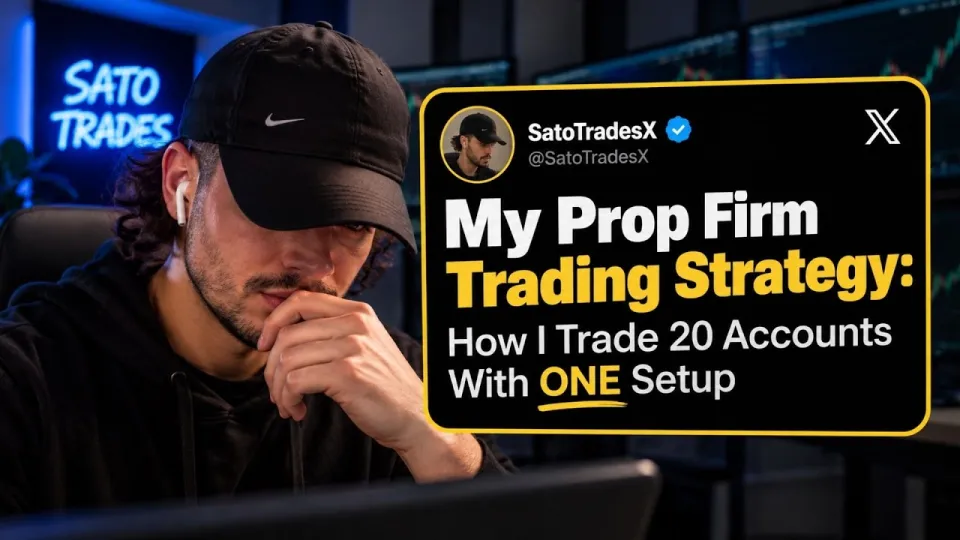
Video: Prop Firm Trading Strategy: How to Pass a Funded Challenge in 2026
· based on the channel Sato Trades
Key takeaways
- Use a mechanical 1-minute futures trading system for precise entries
- Trade key ES & NQ daily and intraday levels for confluence
- Strict risk management protects your funded account from drawdowns
- Set limit orders, stop loss, and take profit before leaving trades
- Scale trading by managing multiple accounts with trade copiers
Passing a prop firm trading challenge requires a well-defined mechanical trading strategy that emphasizes precision, risk management, and discipline. The best prop firm trading strategy uses futures markets, focusing on the 1-minute chart to identify exact entry points around key levels and market structure. Managing risk with fixed stop losses and take profits is essential to protect your funded account and secure consistent payouts. For traders aiming to scale their profits, running multiple accounts with trade copiers is a practical approach.
Mechanical Trading System on 1-Minute Futures Charts
A mechanical system eliminates guesswork by using predefined rules for entries and exits based on price action around marked levels. The strategy centers on ES (E-mini S&P 500) and NQ (Nasdaq) futures, which offer liquidity and tight spreads. Daily and intraday levels are identified from higher timeframe analysis and order flow data, providing confluence points for potential longs or shorts. Traders mark these levels on TradingView and group them to keep the chart clean and organized.
Trading involves waiting for price to approach these levels on the 1-minute chart, then entering based on confirmation from price action signals like pin bars or momentum shifts. This approach allows for quick, precise trades suited to prop firm evaluation phases where consistency and low drawdown are prioritized.
Risk Management Rules to Protect Funded Accounts
Risk management is the backbone of passing prop firm challenges. The strategy mandates setting stop losses and take profits immediately after entry and then leaving the trade to run. This disciplined approach prevents emotional decision-making and large drawdowns.
Key rules include:
- Risk no more than 1% of the account balance per trade.
- Use fixed stop losses aligned with technical levels to avoid being stopped out prematurely.
- Take profits at predefined levels based on market structure and volatility.
- Avoid trading during market conditions that lack clear structure or are too volatile.
By following these rules, traders can protect their accounts and steadily build profits toward the required funded payouts.
Trading Daily and Intraday ES & NQ Levels
Identifying and trading around daily and intraday levels is critical. Daily levels come from the previous day's high, low, and close, while intraday levels are derived from current session order flow and volume profiles.
Steps to use levels effectively:
- Mark daily high, low, and midpoint levels on your chart before the market opens.
- Add intraday levels as the session progresses based on volume spikes and price acceptance zones.
- Look for confluence where multiple levels overlap to increase trade reliability.
- Use these levels as entry or exit points, combined with price action signals on the 1-minute chart.
This multi-timeframe approach helps filter out low-probability trades and pinpoints high-probability setups vital for prop firm evaluations.
Managing Multiple Prop Firm Accounts for Scaling
Scaling is a key consideration for funded traders wanting to grow their capital. The strategy involves trading multiple accounts simultaneously using trade copiers. Platforms like Tradovate support this multi-account management.
Steps for scaling:
- Open several funded accounts with different prop firms or different account sizes.
- Use a trade copier tool to replicate trades across all accounts instantly.
- Maintain identical risk parameters on each account to ensure uniform performance.
- Monitor all accounts to manage risk and comply with each firm's rules.
This method allows traders to multiply their profits without increasing risk per trade.
Common Pitfalls and When Not to Trade
Understanding when to stay out of the market is part of the strategy. Avoid trading during:
- Periods of unclear market structure, such as sideways consolidation without defined levels.
- News events or high volatility spikes that can trigger erratic price movements.
- When your mechanical system signals conflict or no clear entry setup.
Staying disciplined and patient reduces unnecessary losses and preserves your chance to pass the evaluation.
Useful Tools and Resources
Using TradingView for level marking and grouping helps maintain an organized chart. Combining this with daily level reports and tutorials, such as those available through the Sato VIP membership, can enhance your understanding and execution.
Additional tools include trade copiers like Tradecopia for managing multiple accounts and Discord communities for daily level discussions and mentorship.
Useful Links
- Sato VIP for daily ES & NQ levels and tutorials
- Best Futures Prop Firms Guide
- Free Discord community
- Trade copier with SATO discount
Итог
A successful prop firm trading strategy in 2026 combines a mechanical 1-minute futures system, precise daily and intraday levels, and disciplined risk management. Scaling through multiple accounts using trade copiers can amplify gains, while avoiding trading during poor market conditions reduces risk. The described approach, analyzed and taught by the channel Sato Trades, offers a proven path to pass funded challenges and achieve consistent payouts. For traders seeking daily levels and mentorship, visiting Sato VIP is a recommended next step.
Questions & answers
How does the mechanical trading system work for prop firm challenges?
The mechanical system uses predefined rules for entries and exits based on price action at key ES and NQ levels on the 1-minute chart. It removes emotion from trading and ensures consistent, repeatable setups critical for passing evaluation phases.
What risk management rules are essential for prop firm trading?
Traders should risk no more than 1% per trade, set fixed stop losses and take profits before entering a trade, and avoid trading during volatile or unclear market conditions to protect their funded accounts from large drawdowns.
Can I trade multiple prop firm accounts to increase profits?
Yes, scaling by managing multiple funded accounts simultaneously using trade copiers is a common strategy. It allows traders to increase total capital under management while keeping individual trade risk consistent.
Where can I find daily ES and NQ levels to trade effectively?
Daily and intraday ES and NQ levels are often shared by experienced traders on platforms like TradingView or through paid memberships such as Sato VIP, which provides daily levels, order flow bias, and tutorials.
Source: Prop Firm Trading Strategy: How to Pass a Funded Challenge in 2026 · Markdown version